
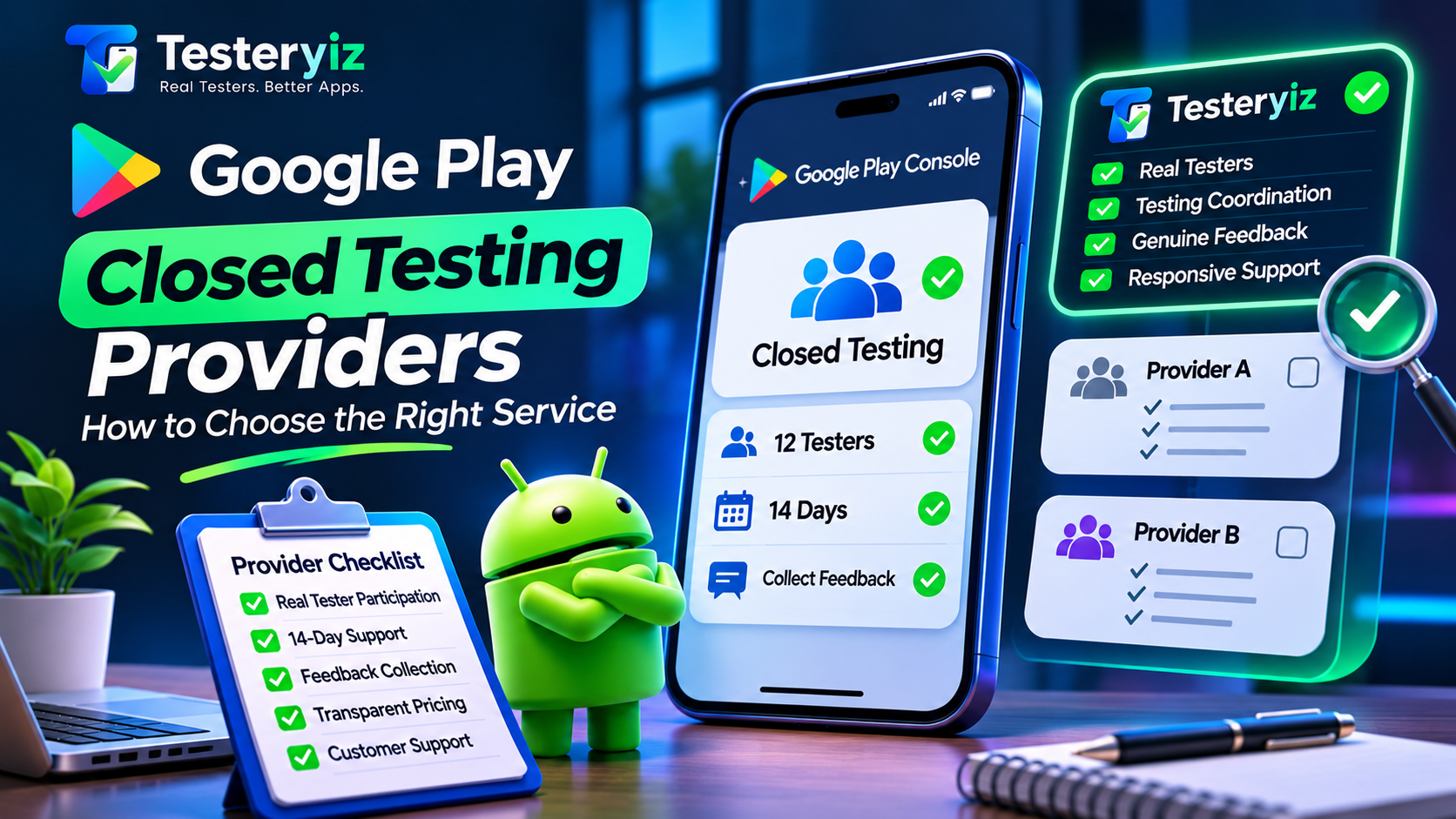
Google Play Closed Testing Providers: How to Choose the Right Service
Finding reliable Google Play closed testing providers is an important step for Android developers preparing to publish their applications on the Google Play Store.
For developers who need 12 testers for 14 days, organizing a closed testing programme can sometimes be challenging. You may not have enough Android users in your personal network, or you may not have the time to coordinate tester recruitment, onboarding, and feedback collection yourself.
This is where a Google Play closed testing provider can help.
However, not every provider offers the same services, testing support, or level of communication. Choosing a provider based only on price or promises can lead to unnecessary problems.
In this guide, we will explain what Google Play closed testing providers do, how to compare different services, what questions to ask before purchasing, and how to choose a suitable testing partner for your Android application.
What Are Google Play Closed Testing Providers?
Google Play closed testing providers are third-party services that help Android developers organize participants for their app's closed testing programme.
Depending on the provider, services may include:
- Tester recruitment and coordination.
- Tester onboarding assistance.
- Google Group or email-list guidance.
- Closed testing participation support.
- Testing progress updates.
- Genuine feedback collection.
- Testing summaries and developer support.
The main purpose is to make the closed testing process easier to organize.
A testing provider does not replace the developer's responsibility to test the application, fix problems, follow Google Play policies, and prepare the app for production.
Why Do Android Developers Need Closed Testing Providers?
Many independent developers build applications without having a large community of Android users available for testing.
Even when an app is technically complete, developers may struggle to find enough suitable participants for a closed test.
Here are some common reasons developers look for testing providers.
1. Difficulty Finding 12 Testers
Eligible personal Google Play developer accounts created after November 13, 2023, must complete a closed test with at least 12 testers who remain opted in continuously for at least 14 days before applying for production access.
Developers who do not have an existing tester community may find it difficult to organize this requirement.
A testing provider can help coordinate tester recruitment and participation.
2. Limited Time for Tester Recruitment
Recruiting participants individually requires communication, invitations, onboarding instructions, and follow-ups.
For developers managing multiple projects, this can become time-consuming.
A provider may help organize these activities so developers can focus more on app development and improvements.
3. Need for Testing Coordination
Simply inviting participants does not complete the testing process.
Developers should also understand how testers join the programme, remain opted in, explore the app, and provide feedback.
A testing provider may offer coordination support throughout the testing period.
4. Need for Feedback and Testing Reports
Feedback from testers can help developers discover usability issues, bugs, and unexpected behaviour.
Some providers also assist with organizing feedback and preparing testing summaries.
This information can help developers understand what needs improvement before production.
Types of Google Play Closed Testing Providers
Not every testing provider follows the same business model. Understanding the different types can help you choose the right service.
1. Tester Recruitment Services
These providers primarily help developers find people who can join their closed testing programmes.
They may provide access to a tester community or coordinate participants for individual projects.
Suitable for: Developers who already understand Google Play testing but need help finding participants.
2. Full Closed Testing Support Services
These providers offer more comprehensive assistance, which may include recruitment, onboarding, participation coordination, communication, and feedback collection.
Suitable for: Developers who want help managing several parts of the closed testing process.
3. Independent Tester Communities
Some providers operate communities where developers and Android users exchange testing opportunities.
These communities may be useful for developers who prefer direct communication with participants.
Suitable for: Developers interested in building long-term testing relationships.
4. App Testing and Quality Assurance Companies
Some companies provide broader Android application testing services.
Their services may include functional testing, compatibility testing, usability evaluation, performance testing, and bug reporting.
Suitable for: Development teams that need more detailed quality assurance beyond the basic Google Play closed testing requirement.
10 Things to Check Before Choosing a Google Play Closed Testing Provider
Before purchasing a service, review the provider carefully.
Here are ten important factors to consider.
1. Genuine Tester Participation
Ask how the provider recruits participants and whether they use supported Android devices.
A good testing process should involve genuine people using your application and evaluating its actual functionality.
Avoid services that focus only on producing a tester count without meaningful participation.
2. Understanding of Google Play Requirements
The provider should understand the applicable Google Play closed testing requirements.
For eligible personal developer accounts created after November 13, 2023, the minimum requirement is 12 testers continuously opted in for at least 14 days.
Make sure the provider understands the difference between tester invitations and actual opt-ins.
3. Tester Onboarding Support
Ask whether the provider helps participants understand how to join your testing programme.
This may include:
- Google Group joining instructions.
- Testing invitation guidance.
- Opt-in link instructions.
- App installation guidance.
- Troubleshooting common onboarding problems.
4. Participation Monitoring
Find out how the provider coordinates tester participation.
For eligible accounts, the 12 testers must remain opted in continuously for the required 14-day period.
If a participant leaves, a replacement does not automatically inherit that person's previous testing days.
5. Genuine Feedback Collection
Ask whether feedback collection is included in the package.
Useful feedback may cover:
- App functionality.
- User interface and navigation.
- Login and registration.
- Performance.
- Compatibility.
- Unexpected errors.
Feedback should reflect actual testing experiences, not fabricated reports.
6. Transparent Pricing
A professional provider should explain its pricing clearly.
Check what is included in the package before making a payment.
For example:
| Service | What to check | |---|---| | Tester recruitment | Are participants included? | | Onboarding | Is setup guidance provided? | | Coordination | Is participation monitored? | | Feedback | Is genuine feedback collected? | | Support | Is customer assistance included? | | Reporting | Is a testing summary provided? | | Replacement | Is replacement support available? |
Compare the services rather than choosing the cheapest package automatically.
7. Customer Support
Communication is important throughout the testing period.
Check whether the provider offers support if participants cannot join, invitations fail, or testing arrangements need attention.
8. Clear Delivery Timeline
Ask when the provider expects to start onboarding and how the testing schedule will be coordinated.
Remember that onboarding time and Google's required 14-day continuous opt-in period are separate.
9. Privacy and Account Security
A tester recruitment provider generally does not need your Google Play Console password.
Avoid sharing unnecessary account credentials or sensitive developer information.
Use the official Play Console controls to manage your testing tracks.
10. No Guaranteed Approval Claims
Be careful with providers that promise guaranteed production access.
A third-party testing provider cannot control Google's review decision.
The developer remains responsible for app quality, policy compliance, genuine testing, and production readiness.
Google Play Closed Testing Providers: Comparison Checklist
Use this comparison table when reviewing different providers.
| Evaluation factor | What a reliable provider should explain | |---|---| | Tester recruitment | How participants are recruited | | Device availability | What Android devices are used | | Onboarding | How testers join the programme | | Testing period | How continuous participation is coordinated | | Feedback | How genuine feedback is collected | | Communication | How developers receive support | | Pricing | What each package includes | | Security | Whether unnecessary account access is avoided | | Replacement | How participant changes are handled | | Approval claims | Whether limitations are explained honestly |
You can use this checklist to compare two or more services before deciding.
Common Mistakes When Hiring a Closed Testing Provider
Developers sometimes make purchasing decisions too quickly.
Avoid these common mistakes:
Choosing only by price: A low-cost package may not include the coordination or support you need.
Ignoring tester quality: A large tester count does not automatically mean meaningful app testing.
Not checking the provider's process: Ask how participants are recruited and guided.
Expecting guaranteed production access: No third-party service can guarantee Google's approval.
Ignoring feedback: Tester observations should be reviewed and used to improve the application.
Sharing account credentials: Never provide your Play Console password to a testing provider.
Taking time to evaluate these points can help you choose a more suitable service.
Why Choose Testeryiz as Your Google Play Closed Testing Partner?
If you are looking for Google Play closed testing support, Testeryiz helps Android developers organize their testing process.
Our goal is to make tester coordination easier for independent developers, startups, and app development teams.
Testeryiz focuses on the following services:
12 Testers for Google Play Closed Testing
Get support with organizing the required tester group for eligible personal developer accounts.
Tester Onboarding Assistance
Receive guidance to help participants join your Google Play closed testing programme.
Testing Coordination
Get assistance organizing participation throughout the testing period.
Feedback Collection Support
Organize genuine tester observations and feedback to help evaluate your application's quality.
Developer Assistance
Get support understanding the closed testing workflow and preparing for the next steps.
Whether you are publishing your first Android application or managing multiple app projects, Testeryiz aims to make closed testing easier to organize.
Visit Testeryiz to explore our Google Play closed testing services and package information.
Our focus is meaningful testing support, transparent communication, and a better testing experience—not unrealistic promises of guaranteed Google Play approval.
Frequently Asked Questions (FAQs)
1. What are Google Play closed testing providers?
Google Play closed testing providers are third-party services that help Android developers organize testers, manage onboarding, coordinate participation, and sometimes collect feedback during closed testing.
2. How do I choose the best Google Play closed testing provider?
Compare tester recruitment methods, onboarding support, participation coordination, feedback collection, pricing, customer support, and transparency before choosing a provider.
3. How many testers do I need for Google Play closed testing?
Eligible personal developer accounts created after November 13, 2023, need at least 12 testers who remain opted in continuously for at least 14 days before applying for production access.
4. Can I hire a service to find 12 Android testers?
Yes. You can use a third-party service to help organize tester recruitment and participation. However, you should verify the provider's process and ensure that the testing is genuine.
5. Do closed testing providers guarantee production access?
No. A testing provider cannot guarantee Google's production access decision. Google evaluates the application and its testing process.
6. Are affordable Google Play testing providers reliable?
Some affordable providers may offer useful services, but price alone does not establish reliability. Check what is included, how testers participate, and whether support is available.
7. Do testers need to use the application during closed testing?
Meaningful app usage is important. Developers should encourage testers to explore relevant features, identify problems, and provide honest feedback. Continuous opt-in and actual app usage are different things.
8. Is Testeryiz a Google Play closed testing provider?
Testeryiz offers Google Play closed testing support, including assistance with tester organization, onboarding, participation coordination, and feedback-related activities. Visit the website to review available services.
Final Thoughts
Choosing the right Google Play closed testing provider can make the testing process easier to organize.
However, developers should look beyond tester numbers and package prices. Genuine participation, clear communication, useful feedback, and transparent service policies are important when evaluating a provider.
Before making a decision, compare different services, ask questions, and understand exactly what each package offers.
A meaningful testing process can help you discover problems, improve app quality, and prepare your application for production.
Looking for Google Play closed testing support? Visit Testeryiz and explore our 12-testers service.